
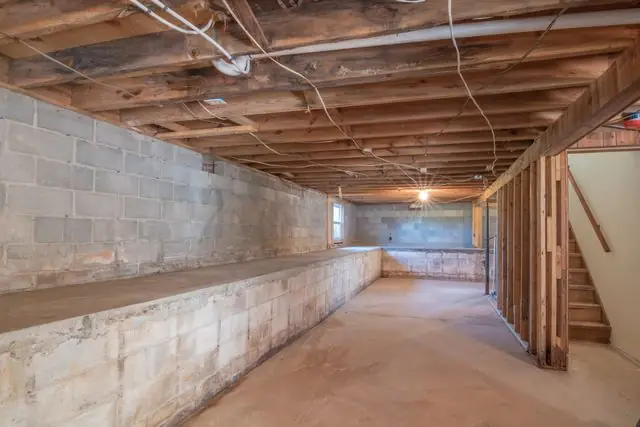
Plenty of houses around Johnson City don't have a full basement. They sit on a crawl space, or a partial basement with a crawl space off one side. The problems are cousins of basement problems: water getting in after rain, damp soil, sweating ducts, and a musty smell that drifts up into the house. The fixes overlap too, but crawl spaces have a few of their own.
Quick honesty note: JC Basement Fix is an estimate-request service. We don't do crawl space work ourselves. When you send a request, we pass it to a local contractor who can look at your crawl space and give you an estimate. This page is here so you know what you're looking at before that conversation.
Signs your crawl space needs attention
- A musty or earthy smell inside the house, often worse in summer.
- Standing water or mud in the crawl space after rain.
- Wet or rotting insulation hanging down between the floor joists.
- White fuzz, dark spots or mold on joists, subfloor or the sill.
- Floors that feel soft, bouncy or cold, or wood floors that cup.
- Sweating ductwork or water dripping off pipes.
- More bugs than usual, or signs of rodents.
None of these alone tells you the fix. They tell you it's worth someone crawling in with a flashlight and a moisture meter.
Water versus humidity: two different crawl space problems
It helps to split crawl space trouble into two kinds, because they're fixed differently.
Liquid water comes in from outside: rain running toward the foundation, a downspout dumping next to a vent, groundwater seeping up through the dirt floor or through a block foundation wall. It shows up as puddles, mud and water lines on the walls, and it usually follows the weather. Johnson City averages around 44 inches of rain a year, so a crawl space with a drainage problem gets plenty of chances to show it.
Humidity is sneakier. Bare soil gives off moisture constantly. Then in summer, warm humid air comes in through the foundation vents, hits the cooler surfaces underneath the house, and condenses, the same way a cold glass sweats. That's why some crawl spaces are wettest in July even when it hasn't rained. Vents that were supposed to dry the space can make this worse in a humid climate.
Many crawl spaces have both. Crawl space waterproofing deals with the liquid water; encapsulation and humidity control deal with the rest.
Crawl space waterproofing
Waterproofing a crawl space means keeping outside water from collecting under the house. It usually starts outside, same as a basement: gutters cleaned, downspouts carried away from the foundation, and soil graded so it slopes away from the walls instead of toward them. Our drainage systems page covers those outside fixes.
If water still gets in, the next step is often an interior drain along the inside of the foundation wall, leading to a sump pit with a pump that sends the water out and away. It's the same idea as an interior French drain in a basement, just in a tighter space and usually in gravel or soil instead of under a concrete slab. Leaking foundation cracks or gaps around pipes can be sealed too; see foundation leak repair for how that works.
If you already have a pump down there, our sump pump installation and sump pump repair pages apply to crawl space pumps as well.
Crawl space encapsulation and moisture barrier installation
Encapsulation is about sealing the crawl space off from the ground and the outside air. The terms get used loosely, so here's what each piece usually means:
- Moisture barrier (vapor barrier): a sheet of polyethylene laid over the dirt floor to stop ground moisture coming up. A basic moisture barrier installation covers the floor with overlapping seams. Thicker, reinforced liners hold up better if anyone ever has to crawl across them for repairs.
- Full encapsulation: the liner covers the floor, runs up the foundation walls and is sealed at the seams and around piers, so the whole space is wrapped.
- Sealing vents and openings: foundation vents and gaps to the outside are closed off, and the access door is sealed.
- Humidity control: once the space is sealed, it needs a way to stay dry, usually a dehumidifier sized for crawl spaces, or a small amount of conditioned air from the house system. A sealed crawl space with no drying plan can end up worse than before.
Wall insulation sometimes gets added at the same time, and old, sagging insulation between the floor joists may need to come out first, especially if it's wet or moldy.
Encapsulation isn't a substitute for fixing liquid water. If water is flowing in, a liner just hides a puddle under plastic. A good crawl space company will deal with drainage first, then seal.
Crawl space repair beyond moisture
Years of damp take a toll on wood. Crawl space repair can include replacing rotted sill plates or joists, adding support where floors sag, and treating mold on framing. Some of that is carpentry or structural work rather than waterproofing. If floors are sagging badly or a foundation wall is cracked and leaning, ask for a structural opinion before anyone seals the space up. Our foundation crack repair page explains how to tell a leaking crack from a moving one.
Choosing a crawl space company
Crawl space work happens where you'll probably never look, so it's worth asking good questions up front:
- What did you find, and can I see photos from under the house?
- Is my problem liquid water, humidity or both, and how do you know?
- What thickness of liner are you proposing, and does it go up the walls?
- How will the space stay dry after it's sealed?
- Where will the sump discharge go, if there is one?
- Do you need to remove insulation or treat mold first?
- What's covered by any warranty, in writing?
Get the plan explained in plain language. If someone wants to sell full encapsulation without explaining where the moisture is coming from, that's worth a second opinion.
Crawl space repair in Johnson City and nearby
We take estimate requests from Johnson City, including Downtown and the ETSU area, plus Gray, Boones Creek and Mountain Home. Tell us what you're seeing under the house, whether there's water after rain, and whether you've noticed a smell upstairs, and we'll pass it to a local contractor who handles crawl space encapsulation and waterproofing. If your house also has a basement with its own issues, see wet basement repair or basement moisture control.